Eve returns to college
Mrs. FletcherEve Fletcher’s return to college is a deliberate attempt to make a life beyond motherhood, not a route to another credential. At Eastern Community College, she enters a classroom as a returning student seeking the hopeful, open-minded self she remembers, just as Brendan’s departure makes the house—and her relationship with him—feel newly uncertain.
The decision to return
Eve already has a master’s degree in Social Work, earned through four years of night classes while Brendan was in elementary school. That earlier education had helped expose a fault line in her marriage to Ted: he resented her absences and the parenting responsibilities they placed on him, and he did not take her work seriously. In retrospect, his dismissiveness seems especially ironic because he is now raising an autistic child and relying on specialists in the caring professions.
This time, Eve is not pursuing a higher degree or polishing her résumé. She wants to read, think, and reconnect with the collegiate self she remembers as more fluid and hopeful than the versions of herself that followed. Classes also give her a reason to leave the empty house twice a week without needing to persuade anyone to come with her. The choice belongs to her, but it takes shape amid the changing family life that Brendan’s departure has brought.
The separation sharpens her attention to whether Brendan will keep in touch. He had promised to send at least one text every day, and Eve stays awake late, playing Words with Friends as a pretext for waiting. For three days he has kept the agreement with brief, cheerfully repetitive reports about how great college is; on the fourth night, no message arrives. Eve knows he is out drinking, but resists texting first because she wants contact to come from him freely. Her return to school is one effort to build a life of her own, even as she remains alert to the possibility that she is becoming peripheral in his.
A first night back
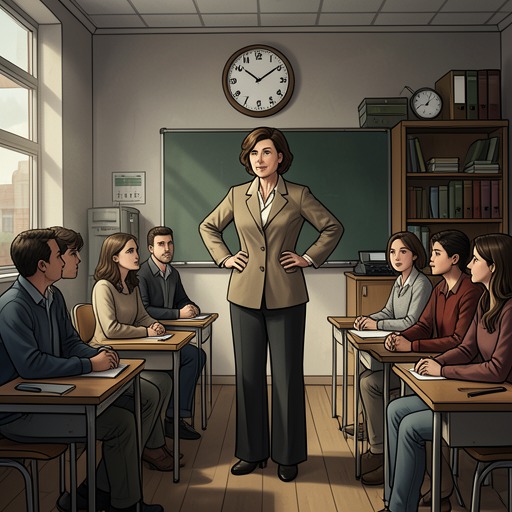
With mild back-to-school jitters, Eve searches the Humanities Building at Eastern Community College for Room 213. She feels relieved to see other returning students in the corridors, some older than she is. Inside, the chairs are arranged in a circle. She chooses one, then notices too late the sexual graffiti carved into the desktop; she covers it with her new notebook and opens to its first page. The blank paper offers a small, tangible image of the fresh start she has wanted.
Eve nods in greeting to the few students already there. A worried-looking Black man, apparently in his early thirties, nods back; the others are absorbed in their phones and do not notice her. The quiet awkwardness of the exchange places her among strangers without making the room feel wholly closed to her. At seven thirty, the instructor, Margo Fairchild, strides in wearing a black pencil skirt and stiletto heels, introduces herself as an adjunct professor, and jokes about the poor pay associated with the position.
The class and its purpose
Eve enrolls in the writing-intensive seminar Gender and Society: A Critical Perspective, which meets on Tuesday and Thursday evenings from seven thirty to nine. The subject is not her particular interest, and the course is her third choice: the classes she preferred, on sustainable eating and Jane Austen adaptations, were full. That compromise underscores that the topic is less important to her than the act of showing up—trying something different, meeting people, and making her world larger rather than withdrawing into solitude.
The seminar nevertheless becomes a place for serious intellectual work. Eve earns a solid A in Margo’s class, and her final paper receives high praise for examining the difficult relationship between radical feminisms and the transgender movement. Her return therefore reconnects personal renewal with sustained study: she is not merely occupying her evenings, but developing an argument on a subject that challenges her to think carefully about feminist politics and gender.
Freedom, distance, and the winter after
The first semester gives Eve a sense of new horizons: she is studying feminist theory, drinking and dancing with friends, and exploring her sexuality. Yet her renewed independence coexists with anxiety about Brendan. Later, while attending a public presentation by Margo, Eve is moved by a slideshow tracing a child’s passage through time and thinks urgently of her son. She recognizes that she has not spoken with him on the phone for almost two weeks; their brief texts have mostly consisted of banalities and apologetic requests for money. She had accepted distance as part of his growing independence, but also sees that she has allowed him to fade into the background of her own mind.
By winter, the freedom of the fall has ebbed. Eve finds it difficult to settle after dark, unable to stay with a book or a film, restless with the sense that something important remains to be done even though there is nowhere she needs to go. She contrasts that agitation with the earlier semester’s classes and social life, and with the domestic routine that now seems to have closed around her again. She tells herself she has withdrawn for Brendan’s sake, although he is the college student in the family and she has already completed her first term with distinction. Her return to school matters precisely because it is not a permanent cure: it reveals both the possibility of reclaiming an independent life and how quickly she can retreat from it.